
Every organisation wants change to deliver quickly. Leaders want momentum, teams want clarity, and stakeholders want proof that the effort is worthwhile. But meaningful organisational change rarely announces itself with one defining moment. More often, it starts quietly: in different conversations, better decisions, and small shifts in behaviour that suggest something important is beginning to move.
That creates a leadership challenge. If we wait until the final benefits appear before deciding whether change is working, we risk missing the early signals that people are starting to think, act and work differently.
The real question is not simply “when will the benefits land?” It is “what should we be looking for before they do?”
Why is change so difficult to predict?
Organisational change is difficult because it is rarely just about new systems, structures or processes. Those may be the visible outputs, but the real test is whether people behave differently as a result. At Clarion, we believe people sit at the heart of successful change. Without understanding culture, embedded habits and natural resistance, organisations may deliver the project but miss the transformation.
How can we tell whether change is happening?
Before people commit to change, they need to understand why it is needed, why now, and how it connects to the organisation’s wider direction. A strong case for change is not just a communication exercise. It is a leadership tool that helps people make sense of uncertainty and see their role in what comes next.
Benefits are usually the way organisations describe the value they expect change to create. But planned benefits do not appear simply because a new product, service or process has launched. They appear when the right outcomes have been achieved.
That is why outcomes matter. Statements such as “we will reduce the number of x” or “we will increase y” give organisations something tangible to track. They show whether the intended change is beginning to emerge and help avoid the common mistake of confusing activity with progress.
At Clarion, we work with clients to map outputs to outcomes and benefits, then identify practical ways to measure progress over time. The organisations that make change stick are often those that define success before delivery begins, not after implementation has finished.
People also move through change at different speeds. Models such as the Kübler-Ross Change Curve can help explain why some people embrace change quickly while others need longer to adjust. One stakeholder group may already be accepting a new way of working, while another remains uncertain or resistant.
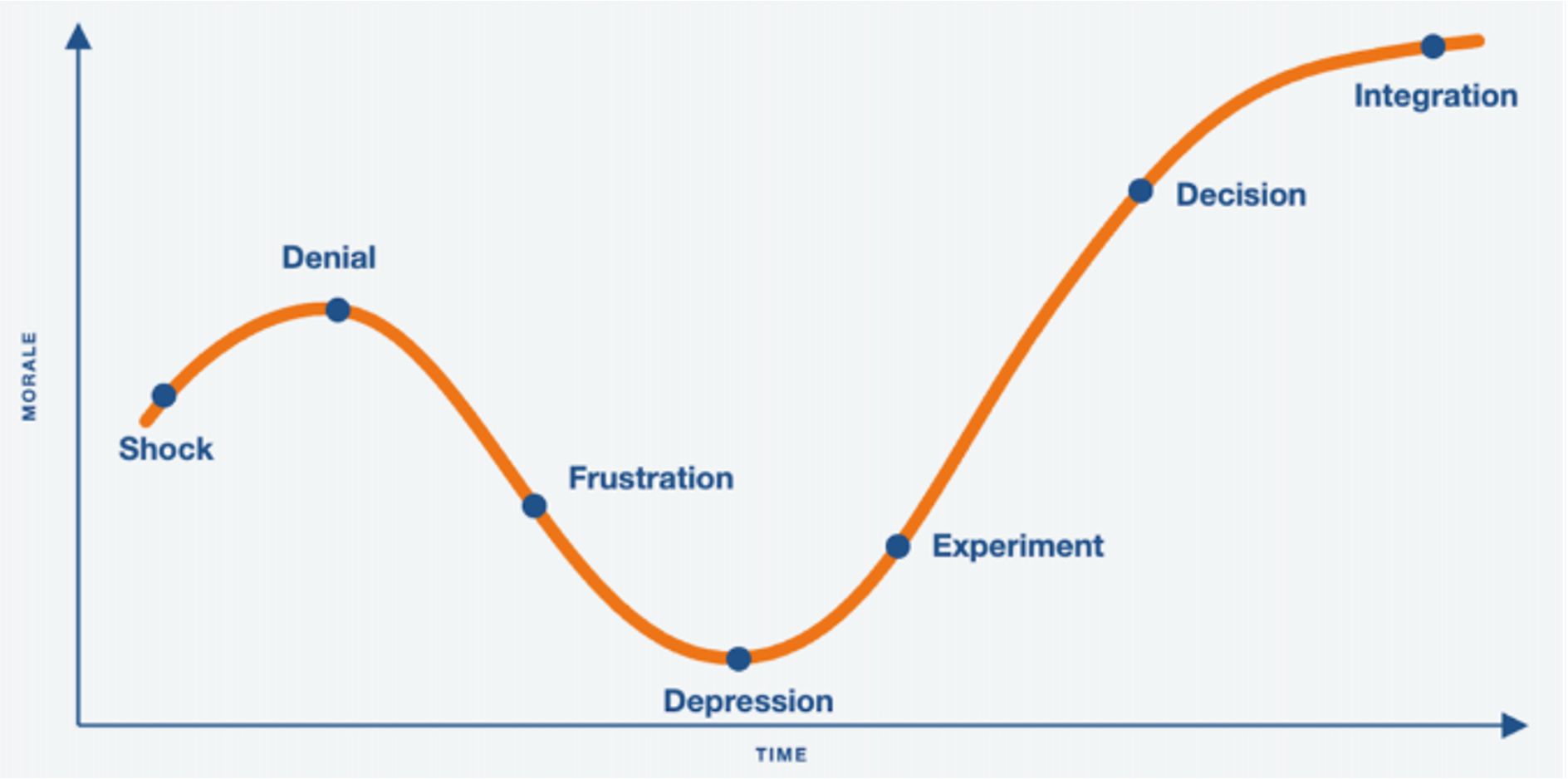
That does not necessarily mean the approach has failed. It may mean people need more time, or that change materials need to be adjusted for a particular audience. This is where change management becomes more than a workstream. It becomes a strategic discipline that helps leaders interpret signals, respond to resistance and keep the organisation moving when progress is not yet fully visible.
What are the early signs that change is happening?
So, what should leaders look for before the headline benefits appear?
The clearest sign is evidence that intended outcomes are beginning to emerge. These may relate to behaviour, performance or process, and they should be compared against a baseline set at the start of the change journey.
In learning and development, for example, the Kirkpatrick model is often used to evaluate whether learning has led to change. Level 2 can show whether knowledge has increased, Level 3 looks at whether learning is being applied in the workplace, and Level 4 considers whether it has contributed to organisational results. The further up the model you go, the harder it becomes to isolate impact, but without measuring outcomes it is difficult to know whether meaningful change has taken place.
How can organisations help change take hold?
There is no single formula for making change happen, but organisations can increase the chances of success by treating change as an ongoing leadership responsibility, not a one-off delivery activity. That means:
Mapping outputs to outcomes and benefits, so each deliverable is linked to the value it is expected to create.
Setting realistic expectations about time, so behavioural change has space to embed.
Using a flexible toolkit, drawing on approaches such as Cialdini's six principles of influence, ADKAR or Kotter’s 8 steps, and adapting when something is not working.
Helping the organisation make change stick, by creating momentum, influencing behaviours and measuring impact beyond implementation.
Tools and models are helpful, but they cannot guarantee change. In The Tipping Point, Malcolm Gladwell explores how small shifts can lead to sudden, unexpected outcomes. The same is true in change management. We can create the right conditions, but some influences will always sit outside our control.
Conclusion
Successful change management is not about forcing people to change or promising a guaranteed outcome. It is about creating the conditions in which change is more likely to happen: helping people navigate uncertainty, building commitment to new ways of working, and measuring whether the intended outcomes are starting to emerge.
If your organisation is investing in change, now is the time to ask whether you are only tracking delivery, or whether you are also measuring the behavioural outcomes that will make change sustainable. Clarion Insight can help you define those outcomes, understand where people are on the journey and build the momentum needed for change to become lasting improvement.