
What three decades of organisational change work has taught me about why the field needs to catch up with itself
I have spent the best part of thirty years working alongside organisations trying to change in some way. Digital transformations, mergers, strategic partnering arrangements, cultural overhauls, leadership restructures ……. I have sat in the rooms where these things are planned, and I have watched what actually happens when they meet reality. The gap between plan and reality is where I have likely learned almost everything useful that I know about change.
What I have learned is that most of what gets called “change management” is built on assumptions that are no longer adequate, and more importantly, on a misunderstanding of what change models are actually for. The models are not entirely wrong either to be fair, but increasingly at odds with the kind of change organisations are actually living through. That is not a criticism of the practitioners, rather the frameworks and tools we inherited were genuinely fit for purpose when they were developed. The problem is that the world has changed faster than the field has (or is willing to).
The old models made sense
Traditional change management emerged from a particular kind of organisation operating in a particular kind of world. Bureaucratic structures, slow moving markets, stable environments and technologies implemented over years rather than months. When disruption came, it typically came in recognisable forms such as a new system or a shift in strategy, as well as coming periodically and not continuously.
The frameworks that emerged from this context reflected that logic. Kurt Lewin's famous three stage model; unfreeze, move, refreeze, assumed that organisations could be brought from one stable state to another (Lewin, 1947). John Kotter's eight-step model of leading change, developed from studying over 100 organisations, was similarly structured around a defined sequence of leadership interventions culminating in anchoring new approaches in the culture (Kotter, 1996). Both models remain genuinely useful when the problem is clearly defined and the solution can be planned in advance.
Before questioning the models themselves, it is worth pausing on what recent research tells us about how they are actually used in practice. A systematic review by Harrison et al. (2021), examining change model application across complex organisational settings, found that Kotter and Lewin remained the most commonly used frameworks, although they were almost never applied rigidly. They were interpreted rather than followed and they functioned as orientation tools or sense-making frameworks as a way to structure conversations rather than step-by-step prescriptions. There is, the authors concluded, no best model. Success was not about which framework was chosen, but rather about how well the system supported the behaviour the change required.
The difficulty is that fewer and fewer situations faced by organisations can be described as having clearly defined problems and solutions that can be planned in advance. The evidence is accumulating that organisations are finding this out the hard way. A 2022 Gartner survey found that employees' willingness to support organisational change had collapsed from 74% in 2016 to just 43%, even as the average employee was now experiencing ten planned enterprise changes per year, up from two just six years earlier. That is not a workforce problem so much as a structural mismatch between the tools organisations are using and the reality those tools are being asked to address.
The world these models were built for no longer exists
That’s not meant to be dramatic, but when I look at the organisations I work with today compared with those I worked with in the 1990s, they are operating in fundamentally different conditions.
Technology is no longer a background factor that gets periodically upgraded. It is a continuous disruptor reshaping roles and business models in real time. The assumptions underpinning a strategy developed twelve months ago are often already out of date. Organisations themselves have become structurally more complex. A decision made in one part creates unexpected consequences in other parts. Dave Snowden's Cynefin framework now widely used in organisational strategy, provides a useful lens here: it distinguishes between complicated problems (which can be solved with expertise and analysis) and complex ones (where cause and effect only become visible in retrospect, and where outcomes emerge from the interactions of agents in the system rather than from deliberate design) (Snowden & Boone, 2007). Most change management thinking is built for the complicated domain. Most real organisational change now happens in the complex one.
And the people inside organisations have changed. There is considerably less appetite for top-down direction, less tolerance for being handed decisions, and a generation of employees who have grown up expecting to be consulted rather than told. I have seen change programmes that would have worked perfectly well in 2005 produce open resistance when applied in the same way today.
Taken together, these shifts mean organisations behave less like the machines of classical management theory and more like what complexity researchers would call complex adaptive systems; entities where outcomes emerge from the interactions between people, rather than from the plans of a few people at the top.
Episodic versus continuous change
One distinction that has genuinely changed how I think about this work is the difference between episodic and continuous change, a framing developed by Weick and Quinn (1999) that I have found one of the most practically useful pieces from different change literature.
Episodic change is the familiar kind, the transformation programme with a plan, a steering group and a defined endpoint. The organisation moves deliberately from one state to another and it generally has a beginning, a middle and an end.
Continuous change is different. It emerges through ongoing adjustment, learning and experimentation. It doesn't have a project plan and It isn't owned by a programme team. It happens in those daily decisions and behaviours of people throughout the system.
Most organisations I work with today are experiencing both simultaneously. The challenge is that the tools and mindsets developed for episodic change don't transfer neatly to continuous change. Trying to manage continuous change like a programme with milestones, RAG statuses, end-of-project reviews tend to slow it down and frustrate the people involved. I have seen this happen countless times and the research backs this up; the same Gartner data shows that by 2023, only 43% of employees believed their organisation was good at managing change at all, down from nearly 60% in 2019 (Gartner, 2023). We appear to be getting worse at this, not better, and precisely because the pace of change has outrun the approaches we are using to handle it.
How change actually spreads
One of the things I have come to appreciate and that I think is genuinely underappreciated in standard change management practice is how change actually moves through organisations. The intuitive model is hierarchical; that is leadership announces the direction, managers cascade the message and people (the workforce) generally comply. Most change communication strategies are still built on this assumption. But it does not reflect what research suggests actually happens.
Damon Centola's work over the past decade has fundamentally revised how we should think about this. In How Behavior Spreads (2018) and the more practitioner-focused Change (2021), Centola draws on experimental research in online social networks to show that complex behaviours (those that require effort, involve social risk, or challenge existing norms) do not spread virally through many weak ties the way a piece of information does. They spread through reinforcement; people are far more likely to adopt a new behaviour when multiple peers in their close social environment are already doing it. This has a counterintuitive implication for change strategy where the objective should not be to spread messages as widely as possible as fast as possible, but to build clusters of adoption that create visible social proof within people's immediate networks (Centola, 2021).
This is not uncommon and is a pattern I have come across a number of times. In one organisation I worked with, a culture change programme that had been formally launched by leadership for eighteen months had barely shifted anything. Even though there was a “compelling” case for change and it genuinely looked like this would help people, nothing shifted. Then a group of respected engineers in one business unit started working differently, talking openly about what they were doing and why. Within six months, adjacent teams were adopting similar practices, not because anyone told them to, but because the social proof was there. Centola would recognise this immediately as it was evidence of a ‘cluster’ becoming a ‘bridge’.
A review of 37 change management models by Errida and Lotfi (2021) reinforces this from a different angle. When change succeeded, it was rarely because a model had been followed correctly. Success was consistently driven by five interacting conditions: strong visible leadership, relentless communication, high stakeholder engagement, ongoing coaching and support, and genuine employee motivation. When change failed, the inverse appeared, namely no clear vision, weak leadership, poor communication, low engagement and no reinforcement. The same organisation, same capability but different outcomes, and in almost every case the model was not the differentiating variable. What mattered was whether the system made the required behaviour clear, compelling, supported and reinforced.
This has real practical implications. It means the question of who carries a change is often as important as what the change is. Identifying and enabling informal networks, building trust between people, creating conditions for behaviour to spread naturally are often more effective levers than another all-staff communication cascade.
Thinking about change as a spectrum
At Clarion Insight, one of the things I keep coming back to with clients is the idea that different kinds of change require genuinely different approaches. This is not an original insight, it draws on the distinction Heifetz and Linsky (2002) make between technical and adaptive challenges, and on the Cynefin framework's discrimination between problem types, but it is one that organisations still consistently get wrong.
At one end of the spectrum sits structured change. The problem is clear, the solution is known, and implementation can be planned and managed. Good project discipline, clear communication and competent execution will get you a long way here. This is where traditional change management is at its best.
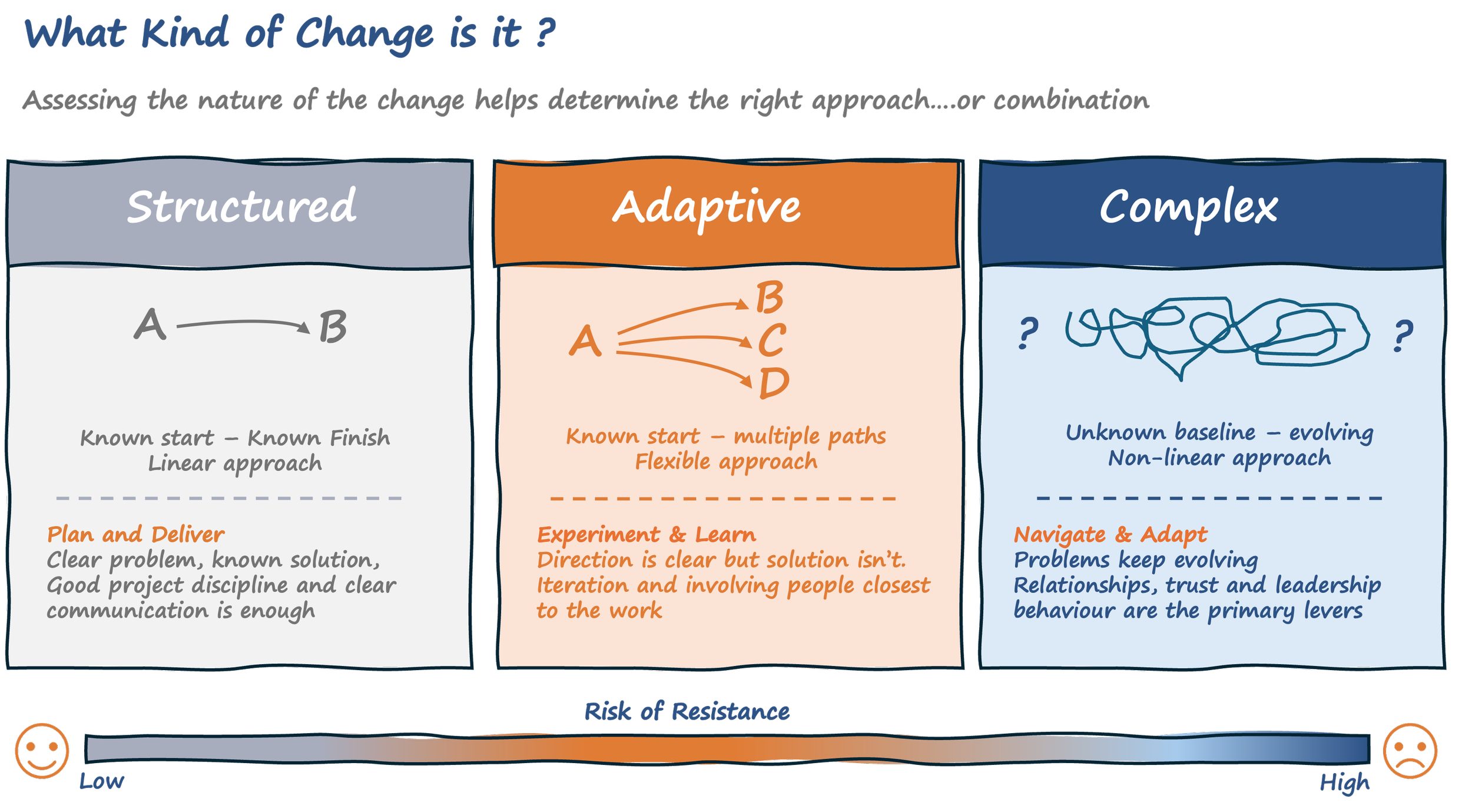
In the middle sits adaptive change. The direction is understood but the solution has to be developed through experimentation and learning. This requires more iteration, more involvement of people closest to the work, and leaders who can tolerate uncertainty rather than trying to eliminate it.
At the other end sits complex cultural change. Here the problem itself keeps evolving. Outcomes depend heavily on the quality of relationships, the behaviour of leaders and the degree of trust across the organisation. You cannot manage your way through this kind of change, rather you have to navigate it.
The mistake I see most often is organisations applying structured approaches to challenges that are fundamentally adaptive or complex. The tools do not fit the problem. And when people experience that mismatch, a rigidly planned transformation programme trying to address something as emergent as culture, I think they stop believing the organisation knows what it is doing. As with any loss of credibility, its very hard to recover. Harrison et al. (2021) make this point plainly, that the highest-performing change efforts did not rely on model purity. They combined approaches and tested rather than imposed change by keeping the focus firmly on whether the system was enabling the behaviour required or not.
From managing change to building adaptive capacity
I would argue that the most important capability organisations need today is not the ability to deliver transformation programmes more efficiently. It is the ability to adapt continuously which is a very different thing. Transformation capability is about mobilising resource behind a defined objective. Adaptive capacity is about being able to keep functioning, learning and adjusting even when the objective is unclear or keeps changing.
In practice, building adaptive capacity means specific things such as cultivating cultures where experimentation is encouraged rather than treated as a sign of failure, what Amy Edmondson, in her research on high-performing teams calls psychological safety (Edmondson, 2018). Without that, learning stops and without learning, adaptation is impossible. Adaptive capacity also means enabling decisions to be made close to where knowledge and relationships actually sit, rather than routing everything through a hierarchy. And it means leaders who understand their job as creating conditions for good work, not controlling the outcomes of every initiative.
It also means something that rarely appears in change frameworks but that which we in Clarion have come to think of as central; and that’s treating relationships as infrastructure. When people across an organisation understand each other, communicate honestly and share a genuine sense of purpose, the organisation becomes fundamentally more capable of absorbing and responding to change. Centola's research would frame this as attending to the social network architecture of the organisation, understanding which clusters exist, where the bridges are, and how to design for the spread of new behaviours rather than simply the communication of new messages (Centola, 2018). That relational foundation is often the determining factor in whether change sticks and it is almost never the thing that gets invested in.
So is change management relevant ?
Back to the original question is change management still relevant? Yes, but not centre stage as it has often been positioned as. The tools have genuine value, the problem is the importance we have placed on them. Structured approaches to change still have genuine value in the right contexts. The problem is not the tools themselves but the assumption (often unspoken and possibly unnoticed) that all change can be managed if you plan carefully enough and communicate well enough.
In a world where change is constant, that assumption is becoming harder to sustain. The data from Gartner, the evidence from network science, the growing body of complexity research all point in the same direction. The organisations that are navigating this well are, in my experience, the ones that have stopped asking how do we manage this change? and started asking how do we become an organisation that can live with change?
That is a harder question. It has no clean answer and no eight-step model. But I think it is the right question. And in my experience, getting the question right is usually where the real work begins.
Gartner (2024). HR Leaders Survey: Top Priorities for 2025. Gartner, Inc.
Harrison, R. et al. (2021). How are improvement approaches applied to healthcare change? A systematic review. BMJ Open Quality, 10(3).
Heifetz, R. & Linsky, M. (2002). Leadership on the Line: Staying Alive Through the Dangers of Leading. Harvard Business School Press.
Kotter, J. P. (1996). Leading Change. Harvard Business School Press.
Lewin, K. (1947). Frontiers in group dynamics: Concept, method and reality in social science. Human Relations, 1(1), 5–41.
Snowden, D. J. & Boone, M. E. (2007). A leader's framework for decision making. Harvard Business Review, 85(11), 68–76.
Weick, K. E. & Quinn, R. E. (1999). Organizational change and development. Annual Review of Psychology, 50(1), 361–386.
References
Centola, D. (2018). How Behavior Spreads: The Science of Complex Contagions. Princeton University Press.
Centola, D. (2021). Change: How to Make Big Things Happen. Little, Brown Spark.
Edmondson, A. C. (2018). The Fearless Organization: Creating Psychological Safety in the Workplace for Learning, Innovation, and Growth. John Wiley & Sons.
Errida, A. & Lotfi, B. (2021). The determinants of organizational change management success: Literature review and case study. International Journal of Engineering Business Management, 13, 1–15.
Gartner (2022). Workforce Change Survey. Gartner, Inc.
Gartner (2023). HR Leaders Survey: Top Priorities for 2024. Gartner, Inc.
Gartner (2024). HR Leaders Survey: Top Priorities for 2025. Gartner, Inc.